Resolver Settings
The resolver answers three questions for every imported record, in this order:
- Does a matching data object already exist? (Element Loading)
- If not, where is the new object created? (Element Creation) - if yes, does it move? (Element Location Update)
- Is the object published afterwards? (Element Publishing)
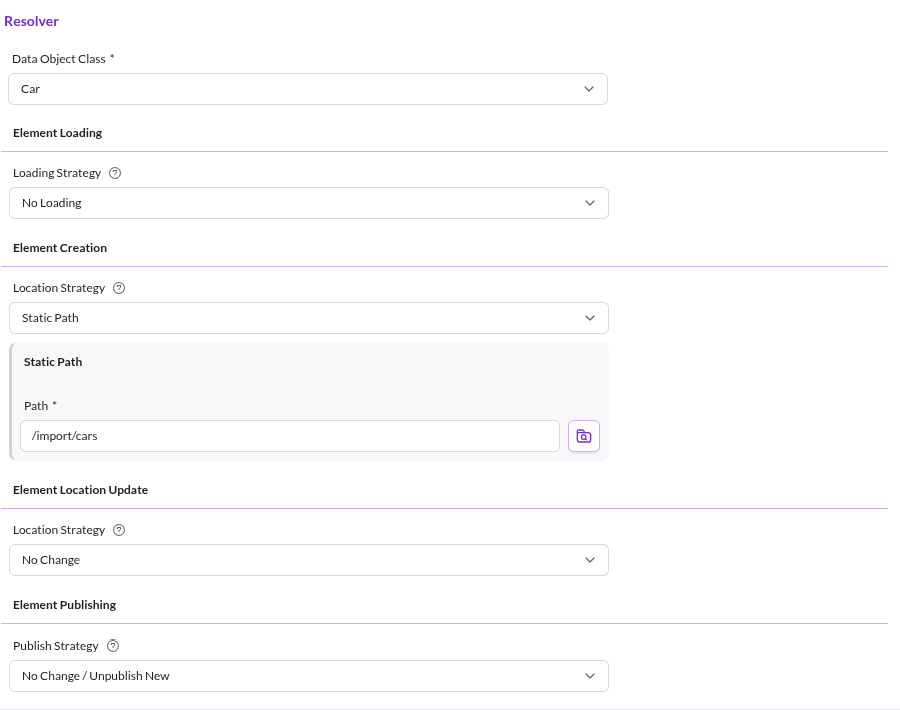

Several strategies need a Data Source Index: the field of the import record that holds the value to look up.
Data Object Class
The Pimcore data object class the records are imported into. It determines which fields the mapping can write to.
Element Loading
How the importer finds an existing data object so it updates it instead of creating a duplicate.
No Loading
Never looks for an existing object. Every record creates a new data object.
Id
Looks up the object by its Pimcore ID.
- Data Source Index: field holding the ID.
Path
Looks up the object by its full path.
- Data Source Index: field holding the path.
Attribute
Looks up the object by one of its attributes, for example a remote ID or an EAN.
- Data Source Index: field holding the attribute value.
- Attribute Name: attribute of the data object to match against.
- Language: for localized attributes, the language to search in.
- Include unpublished objects: also match unpublished objects. Disabled by default, so an unpublished object is not found and the import creates a second one.
Element Creation
Where a new data object is placed. This applies only to records for which Element Loading found nothing.
Static Path
Puts every new object into one fixed folder.
- Path: target folder.
Find or Create Folder
Reads a folder path from the record and uses it. If the path does not exist, the folders are created.
- Data Source Index: field holding the folder path.
- Fallback Path: folder used when the record holds no path.
Find Parent
Looks up an existing data object and uses it as the parent.
- Find Strategy: how the parent is located.
By ID: by Pimcore ID.By Path: by full path.By Attribute: by an attribute value, with these extra settings:- Class: data object class to search, may differ from the imported class.
- Attribute Name: attribute to match against.
- Language: for localized attributes, the language to search in.
- Data Source Index: field holding the value to look up.
- Fallback Path: folder used when the parent cannot be found.
- As Variant: creates the new object as a variant of the resolved parent instead of a child.
Do Not Create
Creates nothing. Records without a matching existing object are skipped, which turns the import into an update-only import.
Element Location Update
Whether an object that Element Loading found is moved.
The available strategies are No Change, Static Path, Find or Create Folder and Find Parent, with the same
settings as under Element Creation. No Change leaves the object where it is.
Element Creation applies to newly created objects, Element Location Update applies to existing ones. A record never runs through both.
A variant cannot change its parent. If a location update strategy would move a variant, the record fails with an error.
Element Publishing
The published state of an imported object.
| Strategy | Existing objects | New objects |
|---|---|---|
Always Publish | published | published |
Attribute Based | set from a field of the record | set from a field of the record |
No Change / Publish New | unchanged | published |
No Change / Unpublish New | unchanged | unpublished |
Attribute Based needs a Data Source Index: the field holding the published state. When the record does not contain
that field, the object is unpublished.