Link Editable
General
The link editable is used for dynamic link creation in documents.
Configuration
You can pass every valid attribute an <a>-tag can have (w3.org - Link),
such as: class, target, id, style, accesskey, name, title, data-*, aria-* and additionally the following:
| Name | Type | Description |
|---|---|---|
reload | boolean | Set to true to reload the page in editmode after changing the state. |
textPrefix | string | Add an icon or something else before Text. |
textSuffix | string | Add an icon or something else after Text. |
noText | boolean | If you need only the <a> tag without text (or only with an textSuffix/textPrefix). |
required | boolean/string | (default: false) set to true to make link and text required for publish, set to linkonly to make only the link required for publish. |
allowedTypes | array | You can limit the available types for this editable by passing the allowed types explicitly. If this option is not used, all types are available. Valid types are: asset, document, object |
allowedSubtypes | array | You can limit the available subtypes for this editable by passing the allowed subtypes (grouped by type) explicitly. If this option is not used, all subtypes are available. |
allowedClasses | array | You can limit the available classes for this editable by passing the allowed object class names explicitly. If this option is not used, all classes are available. |
allowedTargets | array | You can limit the available targets for this editable by passing the allowed targets explicitly. If this option is not used, all targets are available. Valid targets are: (empty string), _blank, _self, _top, _parent |
disabledFields | array | You can limit the available fields for this editable by passing the allowed fields explicitly. If this option is not used, all fields are available. Valid Fields are: text, target, parameters, anchor, title, accesskey, rel, tabindex, class, attributes |
Security policy (URL schemes and attribute keys)
By default, the Link editable renders whatever the document editor enters: any URL scheme
(including javascript:/vbscript:/data:) and any custom attribute key (including event
handlers like onclick). This preserves this editable's historical behavior, but means a document
editor (document-edit permission, not necessarily an administrator) can use it to store a
persistent (stored) XSS payload that runs for every visitor who views or clicks the rendered link
(GHSA-9g27-c28m-8xg5).
To close this, enable it via config:
# config/packages/pimcore.yaml
pimcore:
    documents:
        editables:
            link_sanitizer:
                strict: true
PimcoreCoreBundle::boot() reads this and installs the strict policy for you. If you need a fully
custom policy instead of the boolean toggle, call AttributeSanitizer::setInstance(...) directly
from your own bundle's boot() method - application bundles register at Symfony's default priority
and boot before PimcoreCoreBundle (registered at a lower priority), so an explicit call there
always takes precedence over the config-driven default, regardless of the config value:
use Pimcore\Model\Document\Editable\Link\AttributeSanitizer;
use Symfony\Component\HttpKernel\Bundle\Bundle;

class YourBundle extends Bundle
{
    public function boot(): void
    {
        AttributeSanitizer::setInstance(AttributeSanitizer::strict());
    }
}
The strict policy rejects javascript:/vbscript: paths and most data: URIs (data:image/* other than
data:image/svg+xml is still allowed, e.g. for a downloadable data-uri image), and rejects
editor-supplied attribute keys that look like an event handler (on*) or aren't shaped like a
conventional HTML attribute name. It also stops emitting the editable's own bookkeeping data
(path, linktype, text, parameters, anchor, internal*) as attributes on the <a> tag,
which the permissive default still does for backward compatibility (e.g. linktype="direct").
A target/title/class/data-*/aria-*/... attribute, or an event handler passed only via the
template call (e.g. pimcore_link("x", {"onclick": "track()"})), is unaffected either way.
The permissive default is deprecated since 2026.3 and will be removed in 2027.1, where the strict policy becomes the default. While running with the permissive default, a deprecation is triggered whenever a Link renders a URL or attribute the strict policy would reject. Enabling it today is recommended for any site where document editors are not fully trusted.
Methods
| Name | Return | Description |
|---|---|---|
getHref() | string | Get the path of this link. The path is not HTML-escaped (print it in an escaping context, e.g. Twig auto-escaping); query parameters and anchor are. |
getText() | string | Get the text of the link |
getTarget() | string | Get the target of the link |
getParameters() | string | Get the query params of the link |
getAnchor() | string | Get the anchor text of the link |
getTitle() | string | Get the title of the link |
getRel() | string | Get the rel text of the link |
getTabindex() | string | Get the tabindex of the link |
getClass() | string | Get the class of the link |
getAccessKey() | string | Get the access key of the link |
isEmpty() | string | Whether the editable is empty or not |
Examples
Basic Usage
<p>
    {{ "Visit our" | trans }}
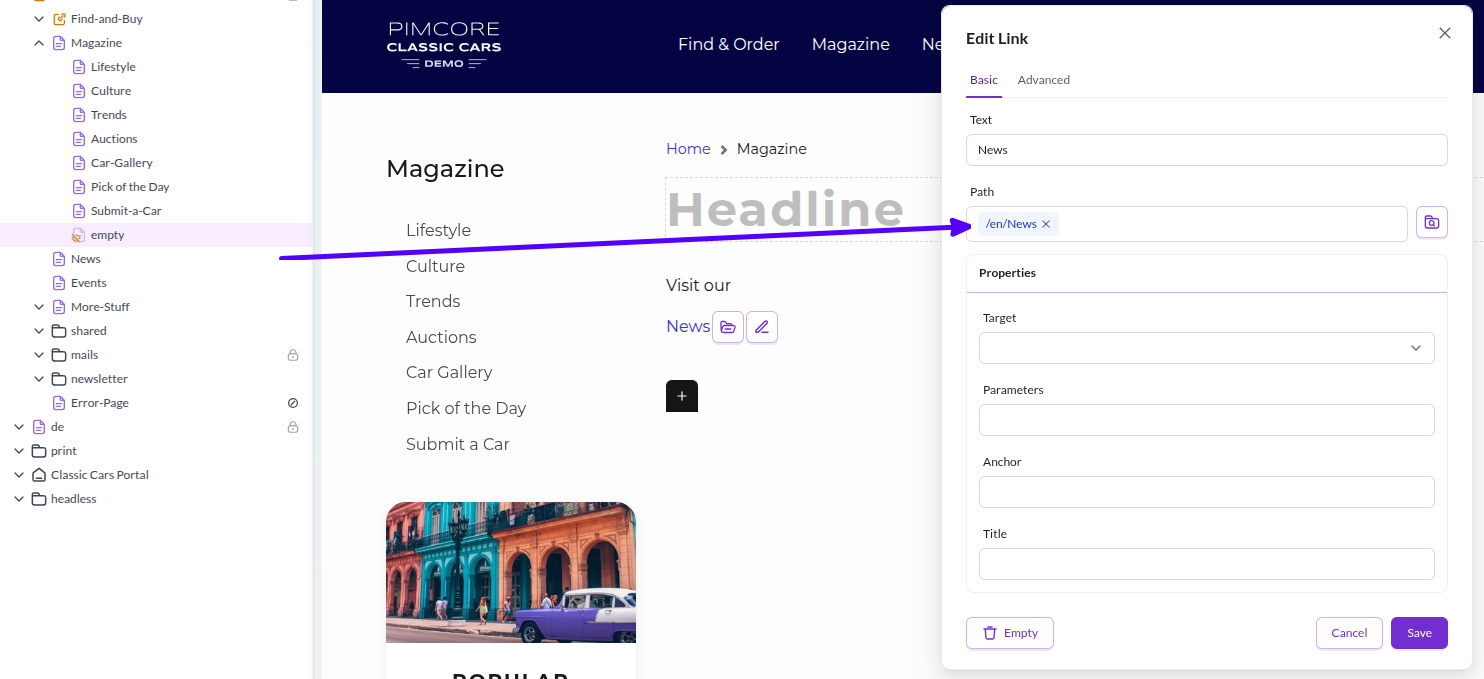
    {{ pimcore_link("blogLink") }}
</p>
You could see the edit mode preview in the picture, below.

And the frontend:


Use Link in the Block Editable
Let's see how to make a list of links with Block.
<h3>{{ "Useful links" | trans }}</h3>
<ul>
    {% for i in pimcore_block("linkblock").iterator %}
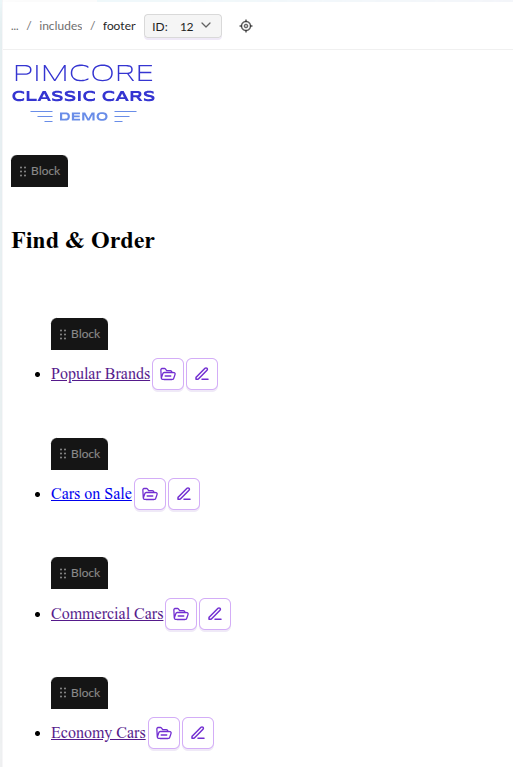
        <li>{{ pimcore_link("myLink", {"class": "special-link-class"}) }}</li>
    {% endfor %}
</ul>
The above example renders a list of links:

Link Generators
Please also see the section about Link Generators
DataObject Link data type
getHtml() / __toString() of the DataObject Link data type (Pimcore\Model\DataObject\Data\Link) are hardened by an
independent policy with its own config (GHSA-h78x-47qg-qjmq); it does not depend on the Document setting above:
# config/packages/pimcore.yaml
pimcore:
    objects:
        link_sanitizer:
            strict: true
            # optional, only used while strict is true:
            blocked_url_schemes: ['javascript:', 'vbscript:']   # default
            block_unsafe_data_urls: true                        # default
With the permissive default (strict: false) the output is unchanged apart from " in href and in the named attributes
(title, class, rel, target, tabindex, accesskey) being escaped as "; a deprecation is triggered whenever
the strict policy would have rejected the href or a free-form attribute. With strict: true, javascript:/vbscript:
and script-capable data: URLs render an empty href, and the free-form attributes string is parsed and re-serialized
(event handlers and malformed tokens are dropped; remaining values are HTML-escaped).
For a fully custom policy, call Pimcore\Model\DataObject\Data\Link\SanitizerPolicy::setInstance(...) from your own bundle's
boot() method; it takes precedence over the config value.