Schema Settings
Schema settings define which data entities (Data Object classes, Assets, Documents) should be exposed via the endpoint. For Assets and Documents, default schemas are provided, for Data Object classes the schema can be defined in the field configuration.
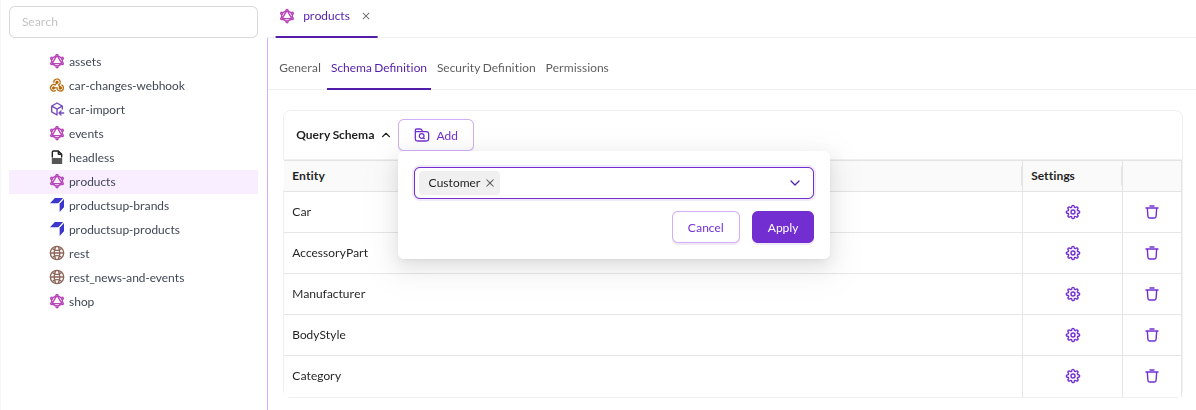

Query Schema
Here you can configure which Data Objects Classes can be exposed.
Available Fields Configuration
When adding a new entity with the Add button, you can access the Available Fields Configuration window with a right-click on the Settings icon. You can then define all the target Data Object Class fields you want to make available.
In addition, you can employ a set of operators.
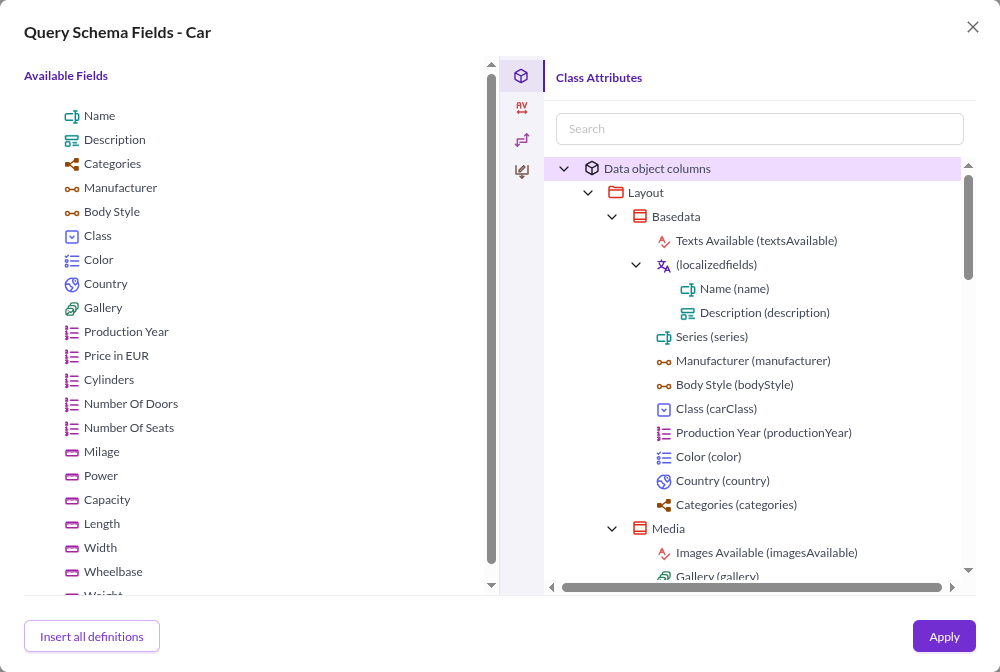

Please note that not all data types are supported yet!
You will get a notice if you try to add an unsupported data type.
Mutation Schema
Here you can decide if Data Objects for the selected class can be created, updated or deleted from the endpoint.
Be aware that a Data Object deleted from an endpoint will be definitively deleted of Pimcore.
Available Fields Configuration
As for the Query Schema field, you can select the fields you want to expose and/or make available for changes in the Available Fields Configuration you can open by clicking on the Settings icon.
Generic Types
Here you can define which data types can be created, read, updated or deleted from an endpoint.
Folder Read Settings
The read setting of the Object Folder and Document Folder types applies wherever a folder can show up in a
response: the parent, children and _siblings fields, relations, relation editables of documents, element
properties and getDocument. The getObjectFolder and getDocumentFolder queries are only part of the schema if
the setting is enabled.
If the setting is disabled, a folder of that type resolves to null (or is left out of a list of elements), the same as
an element that the workspaces do not allow to read. This does not depend on the workspaces and is also true if the
permission check of the endpoint is skipped.